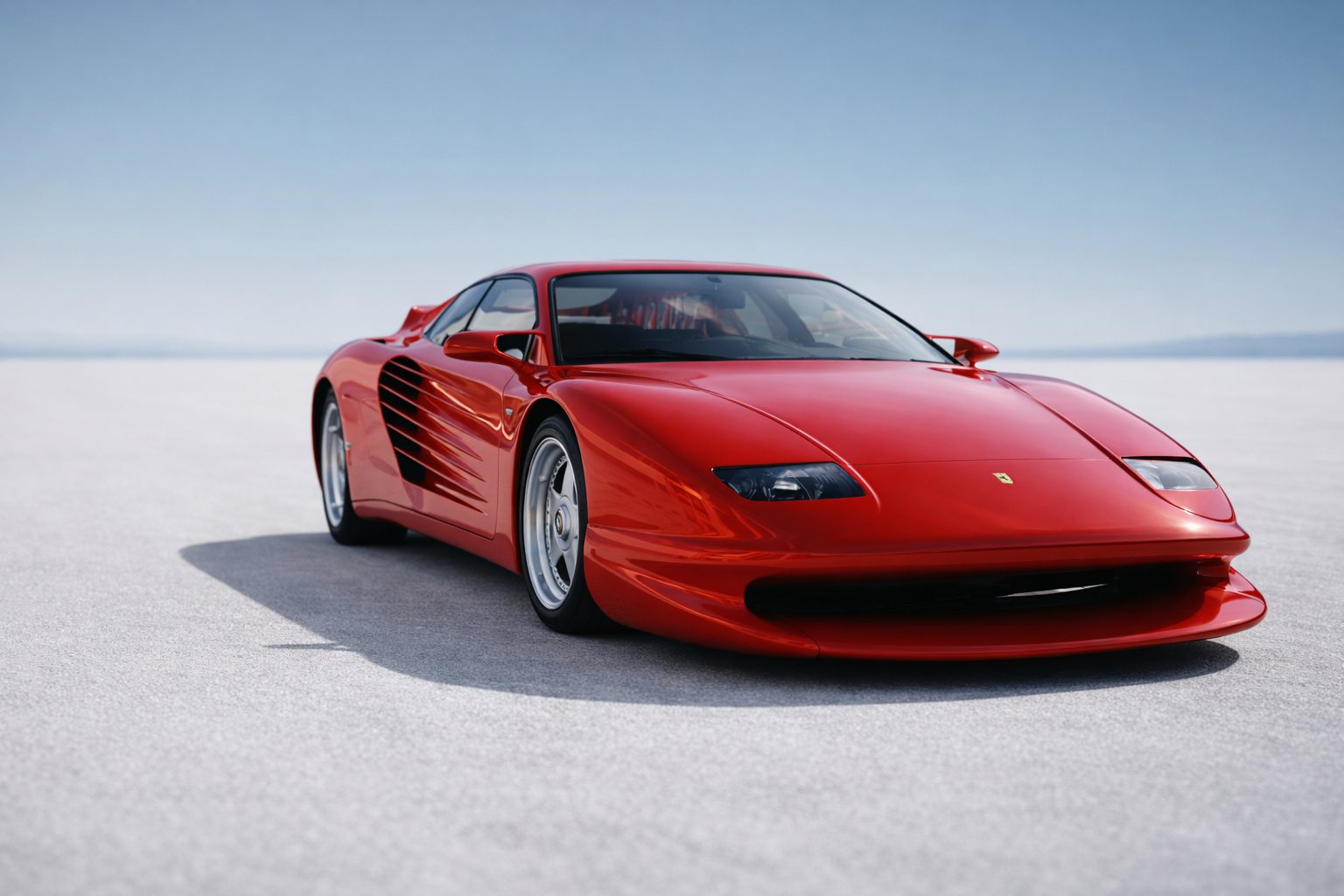
Testa D'Oro
The Record Machine
When Colani Met
Lotterschmid
Luigi Colani was the most radical industrial designer of the 20th century — a Swiss-born visionary who believed that nature's aerodynamic forms were superior to anything a human engineer could devise. His work spanned aircraft, trucks, cameras, and furniture, always following the same principle: the teardrop is perfect.
When Colani turned his attention to automobiles, he needed a builder capable of translating his extreme organic forms into functioning metal and composite. He chose LOTEC.
The result was the Testa D'Oro — Italian for "Golden Head." Based on the Ferrari Testarossa (itself named for its red-painted cam covers — "red head"), the Colani car retained the Testarossa's flat-12 engine but encased it in bodywork so radical that the donor car was almost unrecognisable.
The Testa D'Oro was conceived as a speed record attempt car. Colani's biomorphic design — all flowing curves, no sharp edges, no concessions to convention — was intended to slip through air with minimal resistance. LOTEC's engineering made it real.
The car was built in the late 1980s to early 1990s, a period when LOTEC was simultaneously developing the TT1000 Ferrari and laying the groundwork for the C1000 hypercar. The Testa D'Oro stands as the most visually extreme product of this era — a collaboration between two obsessives who shared no interest in compromise.
"Everything is round in nature. There are no straight lines."
Luigi Colani, 1928–2019
Biomorphic Aerodynamics
Colani's design philosophy was rooted in the study of natural forms — marine biology, bird flight, fluid dynamics. The Testa D'Oro's body has no sharp edges, no flat surfaces, no concessions to convention. Every surface was shaped to reduce aerodynamic drag, with the goal of achieving a coefficient of drag low enough to support a land speed record attempt.
LOTEC's Role
Colani provided the vision; LOTEC provided the execution. Kurt Lotterschmid's workshop in Kolbermoor translated Colani's extreme organic forms into a functioning vehicle — fabricating the bodywork, integrating the twin-turbocharged Ferrari flat-12, and engineering the car to a standard that could withstand the stresses of a high-speed record attempt. It was the same discipline that had produced Inter-Serie champions and Group C race cars, applied to the most unusual brief LOTEC had ever received.