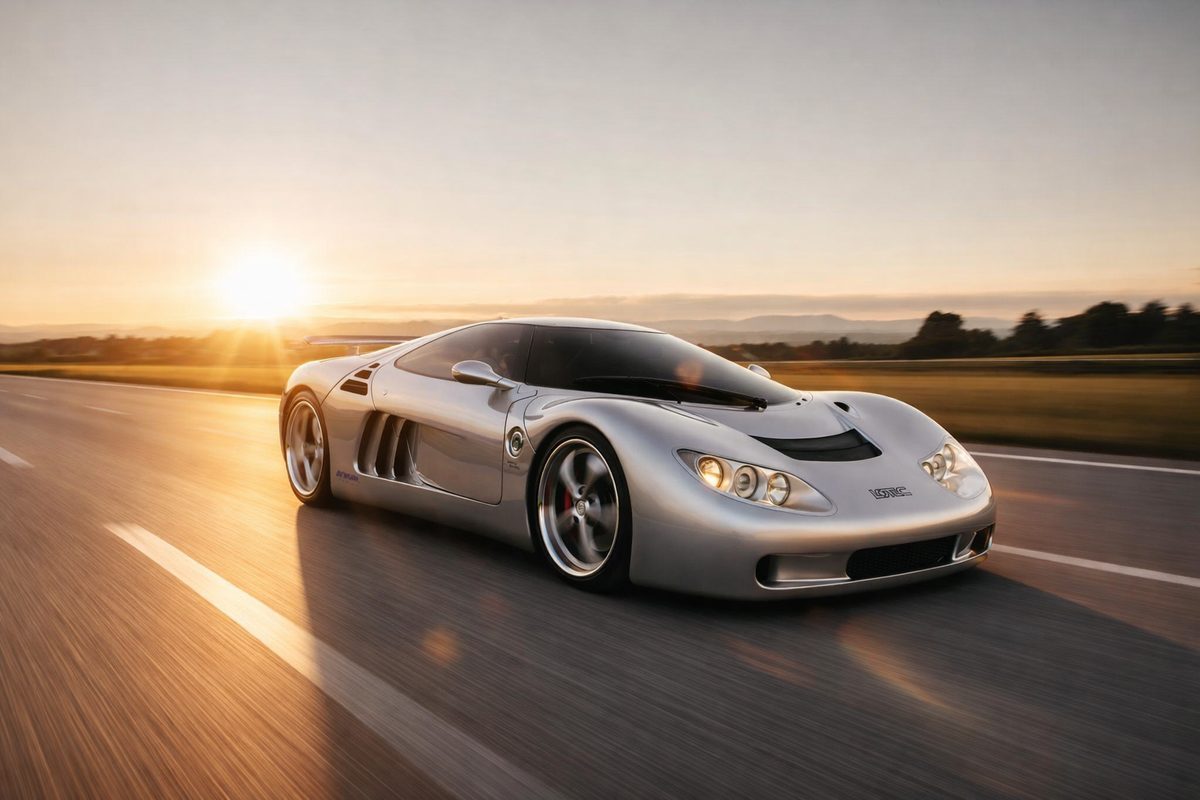
Sirius
The Final Statement
The Last LOTEC.
The Most Complete.
The Sirius was LOTEC's most ambitious production car — and the one that most clearly expressed what the company had become. After decades of racing, tuning, and one-off prototypes, the Sirius was a proper hypercar: designed, engineered, and built entirely by LOTEC in Kolbermoor, Bavaria.
The engine is a twin-turbocharged Mercedes-based V12 of 5,987 cc, managed by the LOTEC TurboTronic system developed with LENZ Elektronik GmbH. Output varies with boost pressure: approximately 1,000 hp at 0.85 bar, rising to approximately 1,200 hp at maximum boost. These are manufacturer-stated figures.
The body was designed in-house — a mid-engined, two-seat supercar with gullwing doors, a carbon fibre monocoque chassis, and 3-piece forged wheels. The speedometer is calibrated to 400 km/h. Top speed and acceleration figures are theoretical estimates consistent with the stated power-to-weight ratio.
The Sirius was built entirely to order, to each customer's specification. It stands as the most complete expression of Kurt Lotterschmid's vision: a car that was entirely his own, from the first sketch to the final bolt.
Mercedes V12 — Twin Turbocharged
The Sirius uses a Mercedes-based 6.0-litre V12 with twin turbochargers and intercoolers. Engine management is provided by the LOTEC TurboTronic system, developed with LENZ Elektronik GmbH of Kolbermoor. The engine is mounted mid-rear, driving the rear wheels through a CIMA 6-speed manual gearbox.
Power is boost-dependent. LOTEC states approximately 1,000 hp at 0.85 bar, rising to approximately 1,200 hp at maximum boost. Torque is stated at 1,100 – 1,320 Nm. These are manufacturer claims.
Carbon Fibre Monocoque
The Sirius chassis is a carbon fibre monocoque with carbon fibre composite body panels. Suspension is independent front and rear with unequal-length A-arms, coil springs, and tube shocks. Braking is by a racing power brake system with ABS. Kerb weight is stated at 1,280 kg.
A top speed of approximately 400 km/h is consistent with the stated power-to-weight ratio and is reflected in the speedometer calibration. This figure is theoretical; no officially timed run has been published.